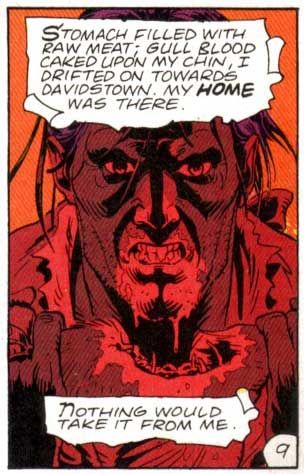
Tales of the Black Freighter was my favourite part of the excellent Watchmen graphic novel, so I'm understandably delighted that a) it's been made b) will be released as a standalone DVD and c) has a trailer.
Enjoy.
Tales of the Black Freighter was my favourite part of the excellent Watchmen graphic novel, so I'm understandably delighted that a) it's been made b) will be released as a standalone DVD and c) has a trailer.
Enjoy.

Why do comic book films, like video game adaptations, invariably disappoint? Such rich, immersive mediums as comic books or video games are very subjective: you can take away something different each time you play or watch, and you can feel an empathy with the story that lacks in other mediums - especially with video games, which are interactive. A disappointing film adaptation can destroy this empathy, and the film appears to pale in comparison to the original format.
Supposedly, 93 comic book films were slated for production in 2009. How many of these existed merely as pencil on the back of a producer's napkin before being dismissed I don't know. Everyone knows comic book movie are disappointing. Look at Spiderman 3, a film which seemed determine to stumble into self-parody with a 'dark' be-quiffed and 'emo' Peter Parker. The Batman reboot is the exception. Superman (2006) flaunts the rule. Everyone knows this the same way everyone knows that Rorschach is the best Watchmen character. Who doesn't like the masked, trench-coat wearing, creepy vigilante, who shows little emotion and wastes fewer words, who refuses to compromise, has a troubled past, Noir-ish sentiments, and cares for no-one, is deceptively strong and quick but vulnerable....I'm getting carried away.
But thats why comics are great: they carry us away. At least as effectively as books or films, the best - and those in the know know that Watchmen is the best - combine the immersion of a good book with the emotional manipulation of a good director. If you haven't read the 1986 Watchmen comic, which examines the morality surrounding the superhero myth (a myth that sustains even in this comic - none of the heroes bar one have super powers); are heroes above the law? Do they have the right to dish out their own brand of justice? And as the tagline roars, who watches the Watchmen? If you haven't read it, read it.
Now: the film. Directed by Zack Snyder, who oozes stylistic flourishes from every pore (he directed 2007's 300), Watchmen, like the comic, follows a group of costumed vigilantes, forced into retirement by a law banning superheroes, who fancy that one of their own is killing off their number one by one. This while Cold War tensions heat up between the US and Soviet Union. A conspiracy is uncovered which threatens the world as we know it.
Getting the film made has been a struggle; Terry Gilliam dismissed it as unfilmable (though Terry Gilliam directed Fear and Loathing in Las Vegas, also deemed unfilmable). Directors, writers, lawsuits and copyright thefts later, the film is slated for release worldwide on March 6, 2009.
But I'm still excited about this one. Director Zack Snyder originally wanted to include the Watchmen's comic-within-a-comic Tales of the Black Freighter (in a world of superheroes, comics feature pirates) in the film, but as this would have increased the runtime catastrophically, it is being released as a standalone DVD. The very fact that Snyder sought to include what is arguably one of the most enjoyably clever and symbolic aspects of the Watchmen comic in the film is exciting fanboys no end. Similar to the way that Hamlet puts on a play-within-a-play which mirrors the events of his father's death to stir the emotions of the murderer King Claudius, Tales of the Black Freighter mirrors the Watchmen story in damning, swashbuckling and desperate style.
Lets hope Watchmen subverts the trend, and becomes The Dark Knight of 2009: the benchmark for the genre.

John Hillcoat, who cut his teeth creating music videos for Nick Cave, is directing the 2009 adaptation of Cormac McCarthy's post-apocalyptic doom-novel The Road. Hillcoat's previous directing role came in 2005's well-received Aussie western, The Propsition. Producer Nick Wechsler was no doubt struck by how well Hillcoat handled the thematic similarities between that story and McCarthy's western novel Blood Meridien. As critic Roger Ebert points out, The Proposition comes close 'to realizing the dread and despair...of that story.' Fitting, then, that Hillcoat has turned his directorial hand towards The Road.
Cormac McCarthy has seen success in Hollywood recently, with the Coen Brothers' to-the-page take on No Country For Old Men receiving critical acclaim. That the movie was ported, chronologically, scene-for-scene from the novel indicates just how McCarthy's linear and direct style of narrative lends itself to the movie screen.
The Road, then. The novel, which won the 2006 Pullitzer Prize, is a post-apocalyptic tale which follows the actions of a father and his son over the course of several months as they pick their way across a North America ravaged by an unexplained catastrophe that we assume has wiped out the majority of life on earth. The sorry duo aim to reach the sea, where they seek solace from the cold. There is no food left on this barren landscape; gangs roam, killing and consuming any survivors. An atmosphere of unease and tension haunts the novel; the main emotion is that of hopelessness. The novel is about nothing if not the relationship between father and son - the father strives to protect their bond as if it is the ember of the last fire on earth.
Viggo Mortensen plays 'the man'; Kodi Smit-McPhee his son. Mortensen, who received an Academy Award nomination for his committed performance as Nikolai Luzhin in Eastern Promises, will hopefully bring the same quiet intensity to the role. Smit-McPhee is best-known for his role as Raimond in the 2007 movie Romulus, My Father, and he received the 2007 AFI Best Young Actor Award for the film. Supporting players include Charlize Theron as 'the wife'; Robert Duvall, Guy Pearce, and Michael K. Williams, known to most as Omar Little from acclaimed television series The Wire.
Perhaps feeling that the movie-going public did not need such a bleak and intense picture in the economically-interesting 2008, the movie was pushed back to an early 2009 release. Presumably, if the terrifying subject matter and general sense of doom that pervades the novel is transferred successfully to film - and all the signs say that it will - audiences can seek some solace in the fact that things could get much, much worse.


